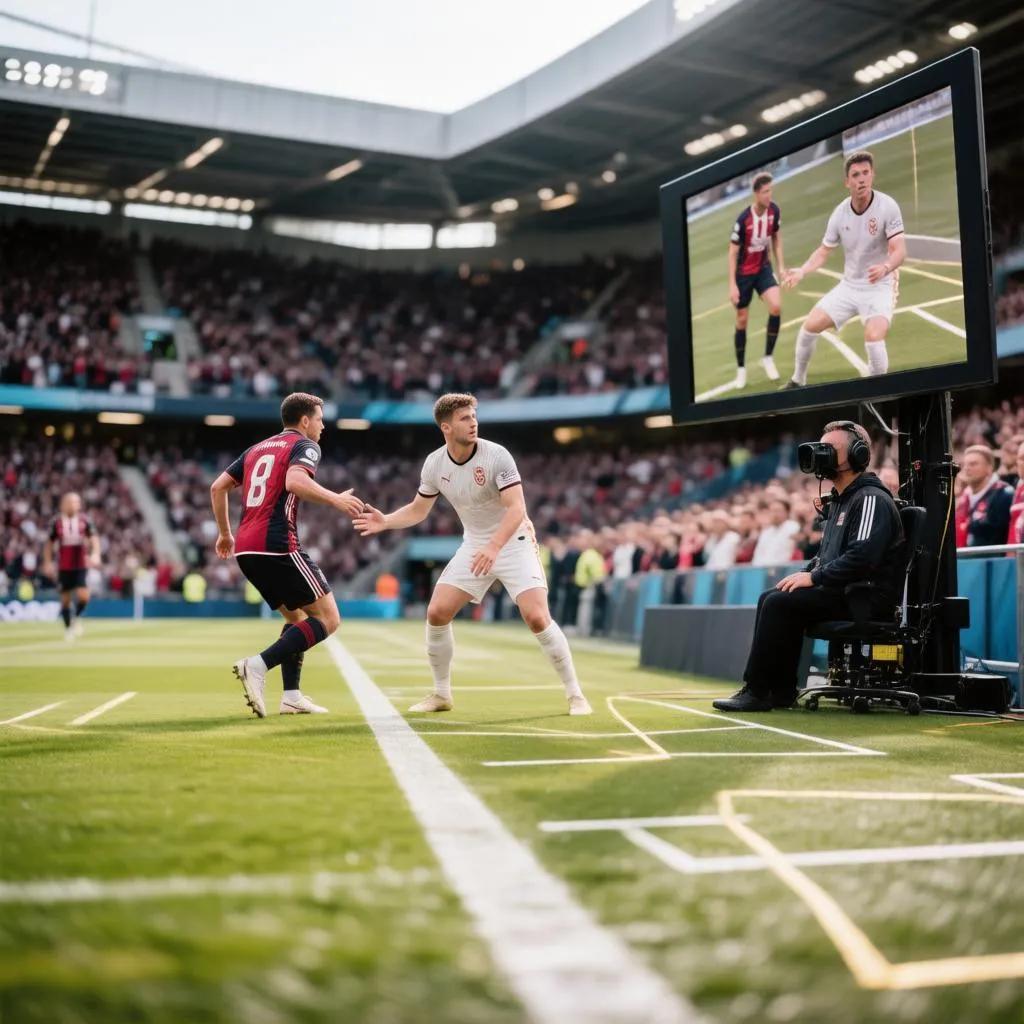
Pre-match betting is an argument settled before the event begins. Live betting is an argument conducted in real time, with the evidence streaming past your eyes and the prices rearranging themselves every few seconds. The two disciplines share a scoreboard but almost nothing else — different information flows, different margin structures, different psychological pressures — and bettors who apply pre-game habits to live markets are solving the wrong problem at the wrong speed.
The live market’s defining feature is the lag between what happens and what the odds say about it. Prices move on goals, points and momentum, but they also move on the algorithm’s model of expected scoring — and that model, sophisticated as it is, cannot see everything a human watching closely can see: a star forward grimacing after a tackle, a defense reshuffled after a substitution, a tennis player whose serve speed has dropped two miles per hour, a basketball team defending the pick-and-roll differently since the last timeout. The gap between the visible event flow and the modeled price is the entire economic territory of live betting. Knowing where that gap opens — and where it is an illusion — is what separates live bettors who beat the market from live bettors who fund it.
How in-game odds actually move
Live prices are not reactions to events; they are reactions to recalculations of probability, and the two coincide less often than the speed of the updates suggests. Understanding the mechanics requires separating the three forces that drive every live line:
- Event updates — goals, points, red cards and injuries trigger immediate model recalculations; these are the moves every viewer sees and the market absorbs almost instantly, because thousands of participants and the book’s own models respond within seconds;
- Time decay — every minute that passes without a score changes the probability distribution even though nothing visibly happened; a 0-0 football match at the seventieth minute is a different market than the same score at the twentieth, and the model prices the shrinking time remaining continuously;
- Flow and risk management — bookmakers adjust prices to balance their own exposure, not only to reflect probability; when heavy money lands on one side, the price moves partly as risk pricing, and this creates occasional gaps between the true odds and the displayed ones.
The interplay of these three forces produces the live market’s characteristic behavior: violent jumps on events, smooth drifts between them, and occasional idiosyncratic moves that reflect the book’s balance sheet rather than the game’s reality. The bettor who understands which move is which stops treating every line change as information.
Where the margins live: the price of speed
The honest starting point for live strategy is the cost structure. Live margins are wider than pre-match ones — often meaningfully so — because the book prices its own uncertainty, its exposure to faster flows and its technology costs. A market that carries a 4% margin pre-match can carry 6% or more in play. This is not a conspiracy; it is pricing the difficulty of the product. The consequence is blunt: a live bet must carry a larger analytical edge than an equivalent pre-match bet just to break even, and most live betting fails this arithmetic before any skill enters the picture.
The corollary defines the discipline. Successful live bettors are not people who predict outcomes better than the market — they are people who identify the specific moments when the displayed price has not yet caught up to an observable reality, and bet only those moments. Volume is the enemy; selectivity is the method.
The information edge: what the screen knows versus what you see
The live algorithm processes numbers: score, time, shots, possession, historical baselines. A watcher of the game processes context. The edges worth pursuing live in the gap between the two, and the categories are consistent across sports. The situations where the human eye holds information the line does not yet reflect:
- Visible momentum shifts that predate the scoreboard — a football team dominating territory for ten minutes before scoring, a tennis player whose return position has moved deeper, a basketball team whose last six possessions produced clean looks; the market reprices on outcomes, and the outcome lags the process;
- Substitution and personnel effects — the algorithm prices the substitution itself; it prices the tactical consequences (a defensive midfielder replaced by an attacker reshapes the expected-goals environment) more slowly, especially in lower-profile leagues;
- Injury and condition signals — a striker holding his hamstring, a quarterback’s throwing motion altered, a tennis player requesting a medical timeout: observable facts that models register only when they become official;
- Referee and game-state patterns — a referee carding aggressively changes the expected number of stoppages and the value of protecting a lead; a game-state read of this kind is invisible to models calibrated on averages;
- Weather changes mid-event — rain arriving in a tennis match slows the courts and shifts serve dominance; wind strengthening in a football match suppresses long-range scoring; both move true probabilities before the models update their venue assumptions.
The unifying principle across all five categories is temporal: the edge exists only during the window before the market incorporates the information. That window is short — seconds to a couple of minutes — and it demands both the attention to notice and the decisiveness to act. A bettor who sees the signal and deliberates for ten minutes is betting a price that has already moved.
When reacting beats pre-game: the structural cases
Live betting is not superior to pre-match betting in general; it is superior in specific structural situations, and knowing them converts the format from entertainment into a tool. The comparison across the main scenarios shows where each format wins:
| Situation | Pre-game advantage | Live advantage | Best approach |
|---|---|---|---|
| Efficient major-league market | Accurate pricing, lower margin | Margins wider, edges rare | Bet pre-game |
| Slow-moving narrative (momentum) | Price anchored on expectations | Line lags visible dominance | Bet live in the lag window |
| Injuries confirmed mid-game | Line priced on full roster | Instant recalibration opportunity | Bet live on confirmed news |
| Weather shifts during event | Forecast uncertain | Observable reality on the field | Bet live as conditions change |
| Contested lower-tier markets | Thin information, wide margins | Same information, but real-time reads possible | Either, with discipline |
| Chasing a bad pre-game position | Original thesis failed | Emotional rescue bets, widest margins | Neither — pass |
The final row deserves its own sentence: the most common live bet is the rescue bet, and it is the most expensive product the book sells. The pre-game position failed, the temptation is to “manage” the position with a live counter-bet, and the combined margin of two bets on one uncertain outcome quietly guarantees that the rescue costs more than the original mistake. Position management through live betting is rational in exactly one case — when the new information genuinely changes the probability assessment — and irrational whenever its motive is emotional.
The timing question: minutes and windows
Every live edge has a shelf life, and mapping the typical windows by sport sharpens the whole discipline. The windows are longest where human judgment matters most and shortest where algorithms dominate:
- Football (soccer) — the longest windows in live betting; the sport’s low scoring makes models conservative after goals, and tactical momentum shifts can take ten or more minutes to reach the price;
- Tennis — serve-dominance shifts and physical condition signals create windows of one or two games; the market reprices aggressively on breaks, which means the pre-break information carries the edge;
- Basketball — the fastest-repricing major market; runs are absorbed within possessions, and genuine edges live almost entirely in injury news and rotation changes rather than in momentum;
- American football — commercial breaks create natural pauses; the market has time to adjust, so edges concentrate in the injury and personnel categories rather than in game flow.
The basketball entry is the honest corrective to live betting folklore: in the fastest, most data-saturated sports, the human-versus-algorithm gap is nearly closed, and pretending otherwise is how recreational accounts donate their balance. The bettor’s honest inventory of their own sport’s gap width is worth more than any general live strategy.
Building a live betting process that survives contact
The discipline that holds all of this together is procedural, because live conditions actively destroy unstructured thinking. A workable process, compressed into habits that can be executed in real time:
- Define the setup before the event starts — know in advance which conditions would make this game bettable live (a specific injury type, a specific score state, a specific tactical mismatch), so that the moment arrives with a plan rather than a feeling;
- Watch the event, not the screen of odds — the price feed is reactive; the game feed is informational; the bettor whose eyes live on the odds column is trading market noise, not events;
- Convert every candidate bet into a probability statement — “I think this team wins 55% of the time from here” is testable against the price; “they look dominant” is not;
- Require the price to clear your margin hurdle — with wider live margins, the required edge grows; a read worth three points pre-game is worth four or five live, and refusing marginal spots is the discipline’s core;
- Cap live volume per event and per day — the format’s speed makes volume creep invisible in the moment; a hard ceiling set before the session is the only reliable brake;
- Log every live bet with the reason it was made — the lag-window thesis is checkable in retrospect only if it was recorded at the time; the log converts experience into calibration.
The sixth habit deserves a note, because live betting is where self-deception operates fastest. The memory of a live session reshapes itself: the bets that won feel like skill, the bets that lost feel like bad luck, and without written theses the bettor never learns whether their lag-spotting actually works. The log is the difference between a gambler with stories and a bettor with a track record.
The psychology that live markets exploit
Live interfaces are engineered for immediacy, and the psychological vulnerabilities they target are known by design. The one-click bet removes the friction that gives deliberation time. The constant price movement manufactures urgency. The visible cash-out offer turns every open position into a decision point that interrupts the original plan. Each feature is individually defensible and collectively corrosive, because they optimize for decision frequency rather than decision quality.
The defenses are structural rather than motivational: pre-set stake sizes that the interface cannot inflate, session time limits that close the tab when the limit arrives, and a personal rule that cash-out decisions follow the original thesis rather than the current feeling. Bettors who manage these pressures with willpower alone are fighting the interface’s design with the weakest tool available; bettors who manage them with rules installed before the session are using the tool the interface cannot override.
Where reacting earns its place
The live market is not a superior version of sports betting; it is a different instrument, priced at a premium, that pays for a specific skill: reading the distance between what is happening and what the odds say about it. That distance opens in identifiable situations — momentum before the scoreboard, injuries before the announcement, tactical shifts before the models recalibrate — and it closes within minutes, which is why the skill is inseparable from the speed of acting on it.
The bettor who approaches live betting with pre-set conditions, probability statements, margin hurdles and hard volume caps holds a genuine instrument. The bettor who approaches it as continuous entertainment holds a continuous bill. The difference between the two is not knowledge of any secret market behavior — the mechanics are visible to anyone who watches prices move for a season — but the willingness to bet rarely, precisely and only when the gap between reality and price is wide enough to pay for the wager. In a format built for speed, the winning strategy is, paradoxically and permanently, patience with a trigger finger — and knowing exactly which moments deserve the pull.