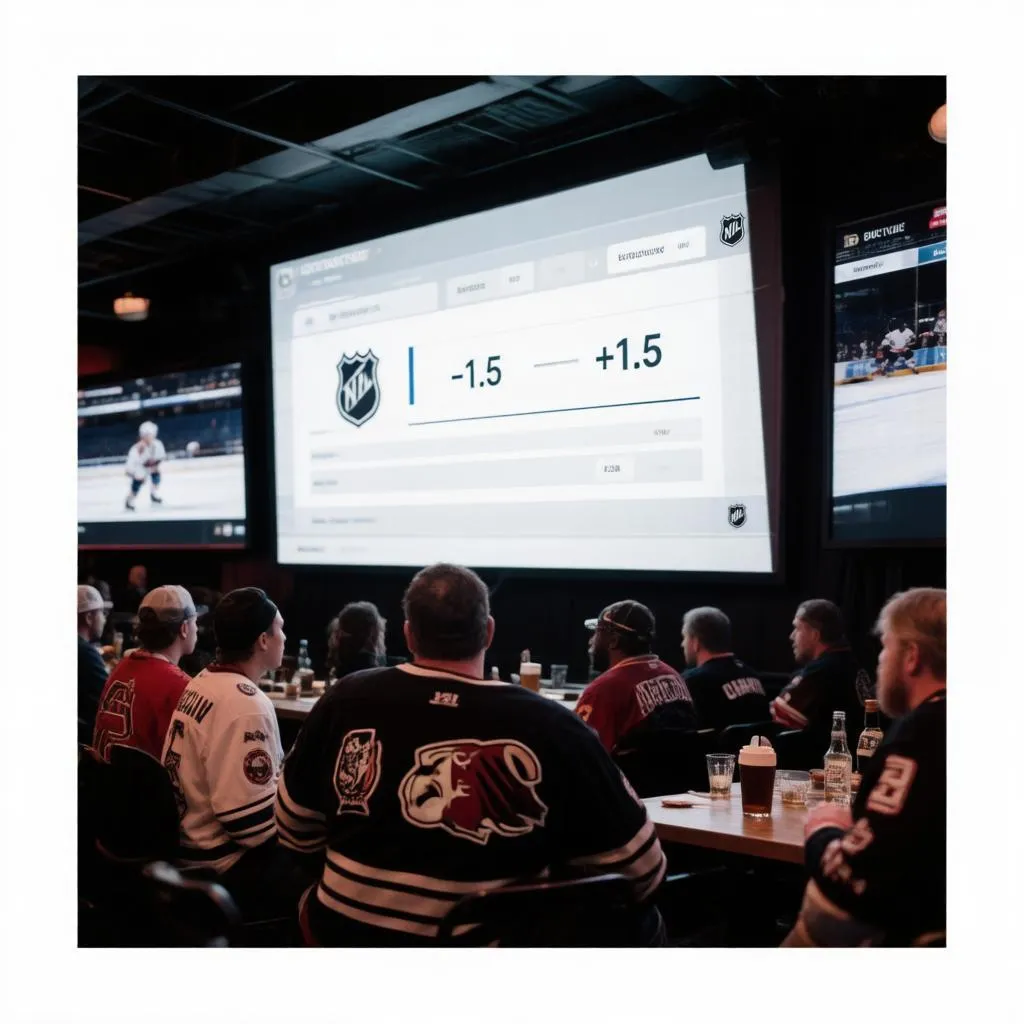
Hockey has its own version of the point spread, and it never changes. In football or basketball, the spread moves from game to game based on how strong each team is. In the NHL, the handicap is almost always locked at 1.5 goals — the favorite lays 1.5, the underdog takes 1.5 — and the only thing that really moves is the price. That fixed structure is called the puck line, and learning to read it is one of the fastest ways to sound like a veteran at the sportsbook window and, more importantly, to bet hockey without tripping over its quirks.
What the puck line actually says
The puck line is a two-goal handicap applied to the final score. The favorite carries -1.5, meaning it must win the game by two or more goals for a bet on it to pay. The underdog carries +1.5, meaning it can lose by a single goal and the bet still wins — or win outright, of course, and cash the same way.
A quick example makes the mechanics plain. Suppose Toronto is listed at -1.5 (+140) against Ottawa at +1.5 (-165). A $100 bet on Toronto returns $140 in profit only if the Maple Leafs win by two goals or more. A $100 bet on Ottawa returns about $61 in profit if the Senators win the game outright or lose by exactly one. Any Ottawa loss of two goals or more sends the Toronto ticket to the window and the Ottawa ticket to the trash. There is no push in a standard puck line bet, because the 1.5-goal margin guarantees a winner on one side.
Because one-goal games are astonishingly common in hockey, the plus side of the puck line wins far more often than the minus side. Favorites laying -1.5 cover roughly 40 percent of the time league-wide, while underdogs catching +1.5 win or come within one goal around 60 percent of the time. That frequency is exactly why the prices differ so sharply: the safe side pays little, the risky side pays a lot.
How puck line odds compare with the moneyline
The most useful habit in hockey betting is putting the moneyline and the puck line side by side before deciding anything. Every game offers two ways to back the favorite and two ways to back the underdog, and the difference between those prices tells you what the market thinks about the likelihood of a one-goal finish.
| Team status | Moneyline example | Puck line example | Best used when |
|---|---|---|---|
| Favorite | -180 | -1.5 (+130) | You expect a multi-goal win, not a nail-biter |
| Underdog | +160 | +1.5 (-190) | You expect the game to stay within one goal |
| Strong home favorite | -220 | -1.5 (+150) | The favorite’s style produces separation |
| Live underdog | +140 | +1.5 (-200) | The underdog relies on tight checking and a hot goalie |
Read the numbers in the second row carefully, because they contain the whole lesson of puck line betting. The underdog at +1.5 costs -190 — meaning you risk nearly two units to win one — precisely because a one-goal loss still pays. Meanwhile the favorite at -1.5 offers plus money, so a $100 stake on a team expected to win by two or more returns more than it risks. Hockey is the only major sport where betting the favorite to win big pays better than even money, and that asymmetry shapes every smart approach to the market.
When the puck line beats the moneyline
Neither line is automatically better; each fits a different read of the game. The puck line is a bet on the shape of the result, while the moneyline is a bet on the result itself. Deciding which one matches your opinion is the entire skill.
Situations that typically favor laying -1.5 with the favorite:
- Elite offensive depth against a tired defense. Teams with scoring spread across four lines wear down opponents’ blue lines by the third period, which is when multi-goal margins get built.
- A favorite facing a back-to-back opponent. Fatigued teams on the second night of consecutive games concede late goals at a higher rate, widening final margins.
- Goaltender mismatches. When the favorite starts its number-one goalie against a struggling backup, the expected gap in goals grows well beyond the moneyline price.
- Empty-net territory. Favorites protecting a one-goal lead in the final minutes often extend the margin with an empty-netter, converting what looked like a one-goal win into a two-goal cover. This single mechanic is why puck line favorites win more often than their moneyline risk suggests.
On the other side, situations that favor taking +1.5 with the underdog are just as recognizable. Tight-checking teams that play well defensively but struggle to score are natural one-goal-loss candidates, and divisional rivals with long histories of close games fit the same profile. Any matchup between two strong defensive systems, or between a hot goaltender and a cold offense, tilts the game’s most likely outcome toward a margin of one — which is exactly what the underdog puck line needs.
Reading the juice like a professional
The prices attached to each puck line side encode the market’s opinion, and learning to decode them turns raw numbers into information. Two habits do most of the work here, and both take minutes to learn.
- Track the relationship between moneyline and puck line prices. A favorite at -150 moneyline with -1.5 at +135 implies a tighter expected game than a favorite at -260 with -1.5 at -105. When the gap between a team’s moneyline and its puck line price is unusually wide or narrow, the market is telling you how likely it believes a one-goal finish to be.
- Watch which side the public leans toward. Heavy public money on famous puck line favorites pushes their price down until the value disappears, while less glamorous underdog-plus-1.5 sides sometimes drift to genuinely attractive numbers. Knowing which side casual bettors gravitate toward tells you where to look for the discount.
Juice also varies more between sportsbooks on the puck line than on the moneyline, because books have different tolerances for the volatility of two-goal margins. Comparing prices across several books before placing a bet is worth real money over a full season — a half-point of juice on hundreds of bets compounds into a meaningful difference in results.
The role of empty nets and late goals
No discussion of the puck line is complete without the empty net, because it silently decides a large share of -1.5 outcomes. When a favorite leads by one with a minute or two remaining, the trailing team pulls its goalie for an extra attacker. If the favorite scores into the open net, the final margin becomes two and the puck line favorite covers. If the underdog scores first, the game ties and heads to overtime — and the puck line favorite loses in every case, because overtime and shootout goals only count as one goal toward the margin.
This late-game mechanic deserves attention in both directions. Bettors who take +1.5 with an underdog leading by one late in the game are effectively betting that the opponent either ties it or that the leading team never finds the empty net — a scenario with genuine risk attached. Bettors laying -1.5 understand that a favorite protecting a slim lead still has a live path to the cover even after falling behind on the scoreboard is off the table. Neither side should be treated as a formality until the final horn sounds.
Building a puck line betting approach
Approaching puck line betting with structure beats approaching it with hunches, and the framework does not need to be complicated. A short routine covers most of the analytical ground:
- Look at each team’s recent results and count how often its games finish with a two-goal margin either way.
- Check the starting goaltenders, because the goalie matchup moves hockey margins more than any skater decision.
- Note rest, travel and schedule spots that tend to either widen or tighten final scores.
- Compare moneyline and puck line prices across books and decide which market actually expresses your read.
After the routine comes the part beginners skip: being selective. The puck line is a high-variance market on the favorite side, and spreading small stakes across many strong spots beats concentrating money on a handful of big prices. Losing streaks of five or six bets happen even with a sound method when the win rate hovers near 40 percent, and bettors who size their stakes for that reality stay solvent long enough for the method to matter.
Where the puck line fits in your hockey betting
The puck line rewards bettors who think in terms of winning margins rather than simple winners. Its fixed 1.5-goal handicap creates a market with clear mathematical logic: favorites cover less often than they win, underdogs lose narrowly more often than they lose big, and the prices reflect both facts. Once you can move between the moneyline and the puck line freely, choosing the one that matches your read instead of your loyalty, hockey betting becomes a genuinely strategic exercise — and the sport’s endless supply of one-goal games becomes a feature to exploit rather than a source of frustration.