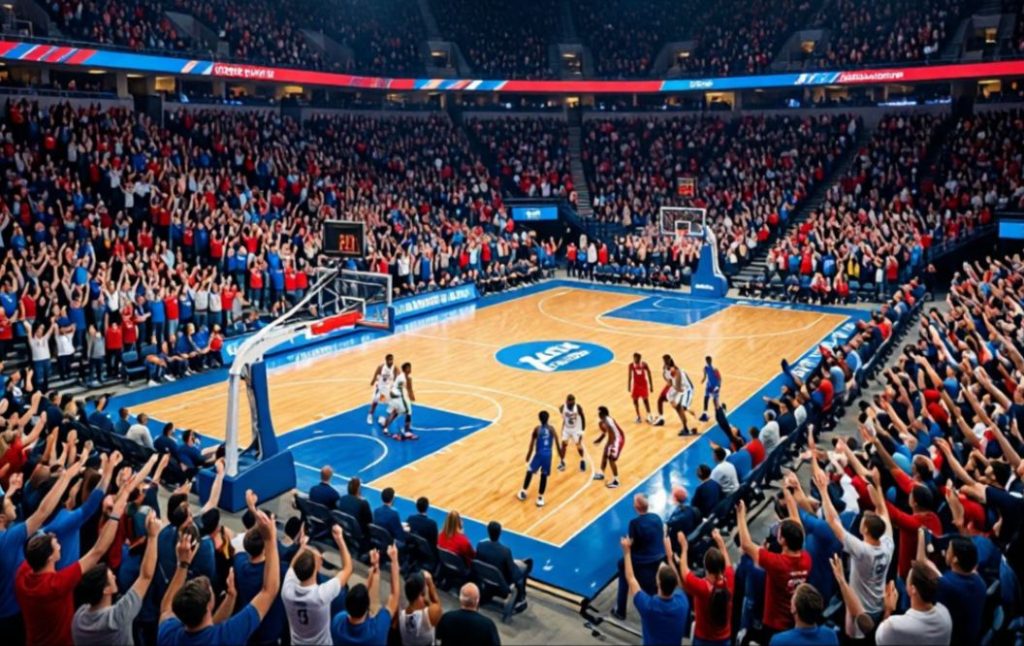
Unlike the polished, uniform environments of professional basketball where every arena features identical dimensions and predictable acoustics, college basketball is a beautiful landscape of architectural chaos. From the claustrophobic, historic brick structures of the East Coast to the massive, multi-purpose domes of the Midwest, no two collegiate playing surfaces are alike. This physical diversity does more than just provide character; it exerts a massive, tangible influence on the outcome of games. For sports bettors, understanding the structural and psychological components of these venues is essential for identifying when the market has failed to properly price the true home court advantage.
The physical anomalies of college basketball arenas
While the baseline dimensions of a basketball court remain standard at 94 by 50 feet, the surrounding environment varies dramatically. In the NCAA, visiting teams often find themselves playing in venues that disrupt their depth perception, shooting mechanics, and communication. These structural quirks can severely impact a visiting team’s shooting percentage, particularly from beyond the three-point arc where visual cues are paramount.
To accurately evaluate how physical environments disrupt visiting teams, analysts must categorize the specific architectural anomalies that alter player performance.
- Unusual background depth: multi-purpose football domes or arenas with seats set far back from the baskets make it difficult for shooters to gauge distance.
- Non-standard lighting configurations: older gyms with dim lighting or spotlights focused directly on the court can create harsh shadows and glare on the backboard.
- Tight sideline proximity: venues where the student section sits mere inches from the court boundaries restrict player movement and amplify verbal distractions.
- Regional altitude variations: high-elevation arenas in states like Colorado or Utah place an immense cardiovascular strain on unaccustomed visiting rosters.
Each of these unique physical factors directly degrades a visiting team’s efficiency, often causing a noticeable dip in shooting percentages and an increase in unforced turnovers. When a team accustomed to playing in modern, well-lit facilities travels to a historic, dimly lit fieldhouse, the transition is rarely seamless. Bettors who identify these physical mismatches before the public does can routinely find value on the home team, especially when oddsmakers rely solely on generic home-court power ratings.
Quantifying the variance across different conferences
Not all home-court advantages are created equal, and applying a flat three-point adjustment across the board is a critical mistake. Power conference teams playing in massive, half-empty arenas often experience a weaker home-court boost than mid-major schools playing in packed, high-energy community gyms. To systematically exploit these differences, we must analyze how home-court advantage varies across different tiers of college basketball.
The following data illustrates the historical performance metrics and average point-spread cover rates for home teams across various conference classifications.
| Conference classification | Average home win percentage | Average point differential | Cover rate as home favorite | Primary environmental driver |
|---|---|---|---|---|
| Mid-major gyms | 63.5% | +4.8 points | 52.8% | Extreme crowd proximity and low ceiling acoustics |
| Power-five arenas | 61.2% | +3.5 points | 49.2% | High-capacity seating with professional floor layouts |
| High-altitude venues | 67.1% | +5.9 points | 54.5% | Physiological fatigue and reduced oxygen recovery |
| Low-tier conference facilities | 58.4% | +2.1 points | 48.1% | Low fan attendance and minimal crowd noise impact |
This breakdown reveals that mid-major and high-altitude environments consistently outperform the standard home-court expectations set by major sportsbooks. While the betting public often associates famous power-five programs with the most intimidating atmospheres, the data proves that smaller, more compact venues and extreme geographic locations generate much more reliable betting value. Understanding this distinction prevents bettors from overpaying for the reputation of a famous venue while ignoring the quiet efficiency of a mid-major powerhouse.
Psychological pressure and the student section factor
Beyond the physical layout of the building, the human element plays a decisive role in NCAA home-court dynamics. College athletes are young, emotionally volatile, and highly susceptible to the pressure cooker environments created by passionate fanbases. Unlike seasoned NBA veterans, a nineteen-year-old point guard can easily lose composure when faced with thousands of screaming students chanting personal jeers from behind the baseline. This pressure directly influences officiating, as referees are subconsciously swayed by the collective roar of a home crowd during close, high-leverage calls.
Strategic betting angles to exploit home court bias
Capitalizing on home-court discrepancies requires a systematic approach that moves beyond simple intuition. Bettors must learn to isolate specific game scenarios where the unique characteristics of an arena are amplified, creating highly skewed odds that can be exploited for long-term profit.
Implementing a structured evaluation process allows analysts to quickly filter out efficiently priced lines and focus entirely on high-value home scenarios.
- Target elite free-throw shooting teams on the road: visiting rosters that excel at the free-throw line are far less vulnerable to crowd-induced pressure in the final minutes.
- Fade high-tempo teams in slow-paced home environments: fast-breaking teams often struggle to establish their rhythm when playing in cramped, slow-tempo arenas.
- Back home underdogs in conference rivalry games: emotional home crowds consistently elevate the performance of inferior teams when playing a hated local rival.
- Identify travel-weary opponents on the second leg of road trips: backing a rested home team against a visitor playing their second road game in forty-eight hours offers a massive physical advantage.
Applying these targeted strategies ensures that your wagers are placed on games where the home-court advantage is not just a statistical abstract, but a tangible competitive edge. By focusing on how specific team styles interact with unique arena environments, you can consistently stay ahead of the oddsmakers’ adjustments. This disciplined, detail-oriented approach turns the chaotic atmosphere of college basketball into a highly predictable source of betting value.
Embracing the home environment
In the end, the court itself is one of the most powerful and underappreciated variables in college sports betting. While casual fans look at team rosters and recent win streaks, true value is often found by analyzing where those games are being played. By looking at how unique stadium layouts, student fanbases, and geographic locations alter the flow of a game, you can easily find the gaps in the betting market. In a sport where the home court is so influential, mastering these environmental factors is the ultimate key to building a winning strategy.