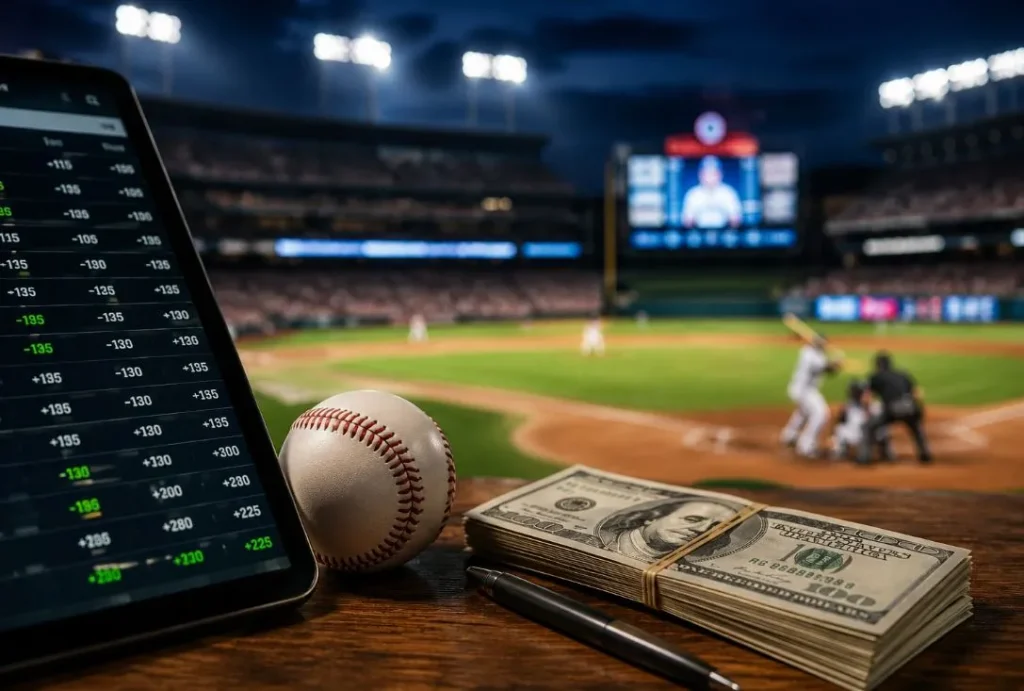
MLB moneyline betting looks simple because the question is simple: which team wins the game? There is no spread to cover and no total to calculate. If the team you back wins, the bet wins. If it loses, the bet loses. That clean structure is one reason moneyline betting is often the first baseball market new bettors try.
The simplicity can be misleading. Baseball is a high-variance sport, and the moneyline price often carries more information than the team name. A favorite is not automatically a smart bet. An underdog is not automatically a risky guess. The number beside the team tells you how much the sportsbook is charging for that side, how likely the market thinks the outcome is, and whether the potential return is large enough for the risk.
Reading MLB moneylines well means moving past “who is better?” and asking a sharper question: is this price fair for this matchup? That question matters because baseball is played almost every day, starting pitchers change the shape of games, bullpens wear down, lineups rotate, and even elite teams lose many times across a 162-game season.
The moneyline number is a price, not a prediction
A moneyline is written with either a minus sign or a plus sign. The minus sign shows the favorite. The plus sign shows the underdog. This does not mean the favorite is certain to win or the underdog is expected to lose badly. It only shows the price attached to each side.
If the Dodgers are -180 against the Rockies at +150, the Dodgers are the favorite. A bettor would need to risk $180 to win $100 in profit at -180. A bettor who takes the Rockies at +150 would win $150 in profit for every $100 staked if the Rockies win.
That difference is the whole structure of moneyline betting. Favorites cost more because they are considered more likely to win. Underdogs pay more because they are considered less likely to win. The sportsbook is not giving a moral judgment on the teams. It is offering a market price.
A quick way to read common moneyline prices is to translate them into plain language.
| Moneyline price | Team status | What the number means | Rough implied probability |
|---|---|---|---|
| -250 | Strong favorite | Risk $250 to win $100 | 71.4% |
| -150 | Moderate favorite | Risk $150 to win $100 | 60.0% |
| -110 | Slight favorite or near-even side | Risk $110 to win $100 | 52.4% |
| +110 | Slight underdog | Risk $100 to win $110 | 47.6% |
| +160 | Clear underdog | Risk $100 to win $160 | 38.5% |
| +250 | Big underdog | Risk $100 to win $250 | 28.6% |
These percentages are not pure predictions because sportsbook margin is built into the market. Still, they help you understand what the line is asking you to believe. A -250 favorite needs to win very often to justify the price. A +160 underdog does not need to win most of the time to be a profitable idea over a large sample, but it does need to win more often than the price suggests.
How to calculate favorites and underdogs
American odds look strange at first, but the logic becomes easier once you separate negative and positive numbers.
For negative odds, the number shows how much you must risk to win $100 in profit. At -200, a $200 stake wins $100 profit. A smaller stake scales down. If you stake $50 at -200, the profit is $25, and the total return is $75 including the original stake.
For positive odds, the number shows how much profit a $100 stake would win. At +180, a $100 stake wins $180 profit. A $50 stake wins $90 profit. The total return includes both the profit and the original stake.
The conversion into implied probability is useful because it forces the bettor to think in percentages rather than feelings.
For negative odds:
Implied probability = odds ÷ (odds + 100)
The minus sign is ignored for the calculation. A -150 favorite becomes 150 ÷ 250, which equals 60%.
For positive odds:
Implied probability = 100 ÷ (odds + 100)
A +150 underdog becomes 100 ÷ 250, which equals 40%.
This is where moneyline betting becomes more analytical. If you think a -150 favorite wins around 60% of the time, the price is roughly fair before considering margin. If you think that same team wins only 54% of the time, the favorite may be overpriced. If you think a +150 underdog wins 45% of the time, the underdog may offer value because the market is pricing it closer to 40%.
The goal is not to guess winners one game at a time. The goal is to identify prices that are better than the true chance of the outcome.
Why MLB moneylines move so much
MLB lines can move quickly because baseball has several variables that matter more sharply than in many other sports. The starting pitcher is the most obvious. A team can look completely different with its ace on the mound than it does with a back-end starter or emergency call-up. If a listed starter is scratched, the moneyline may shift dramatically.
Lineups also matter. Baseball teams rest players often, especially during long road trips, day games after night games, and stretches with many games in a row. A team missing two important hitters may still be the same brand name, but it is not the same betting proposition.
Bullpen fatigue is another major factor. A team may have won the previous night but used four high-leverage relievers to do it. The next day, the manager may have fewer trusted arms available. That can change the value of a favorite, especially in games where the starter is unlikely to pitch deep.
Weather and ballpark conditions matter too. Wind direction, temperature, humidity and park dimensions can affect scoring environment. A high-scoring setup can increase variance, which sometimes makes expensive favorites less attractive. A lower-scoring setup can make one pitching edge more valuable, but it can also keep underdogs alive longer.
Before reading a moneyline as good or bad, it helps to check the baseball-specific details behind it:
- Confirm the starting pitchers and whether the sportsbook uses listed-pitcher rules.
- Check lineups, especially key hitters, catchers and late scratches.
- Look at bullpen usage over the previous two or three games.
- Consider travel, rest and whether the team is in a difficult schedule spot.
- Review home and road splits, but avoid treating small samples as certainty.
- Compare several sportsbooks to see whether one price is clearly better.
- Ask whether the line has already moved too far from the opening number.
This process does not guarantee a winning bet. It simply prevents the most common mistake: betting a team name without understanding why the price exists.
Favorites: safer on paper, expensive in practice
Favorites attract attention because they look more likely to win. In MLB, however, the better team loses often enough that heavy favorites can become dangerous if the price is ignored. A -220 favorite may win more often than the opponent, but the bettor has to risk a lot for a smaller profit. One upset can wipe out several smaller wins.
The danger is psychological. A bettor may think, “This team should win,” and ignore whether the payout is worth the risk. But moneyline betting is not about picking the team most likely to win. It is about paying the right price for that chance.
A favorite can be reasonable when the starting pitcher edge is strong, the lineup is healthy, the bullpen is rested, the opponent is weak in the relevant matchup, and the price has not become inflated. A favorite can be poor value when the number is too expensive, the public is heavily backing the recognizable team, or the matchup is closer than the market suggests.
The most important habit with favorites is to avoid turning them into automatic parlay pieces. Many bettors add large favorites to parlays because they feel “safe.” In baseball, that safety can be overstated. A strong MLB team can lose to a weaker team because of one bad inning, one bullpen mistake, one weather-influenced home run or one quiet offensive night.
A favorite is still a bet with risk. The minus sign only says the market expects it to win more often than the opponent. It does not say the bet is safe.
Underdogs: bigger payouts, but not all plus prices are value
Underdogs are attractive because the payout is larger. A +140 winner can cover several small losses more easily than a -180 winner. Baseball is also more underdog-friendly than some sports because games are lower-scoring than basketball and more pitcher-dependent than football. One strong starting pitcher can keep a weaker team competitive for six innings. One swing can change the result.
Still, taking underdogs blindly is not a strategy. A plus price only becomes interesting if the team’s real chance is better than the market’s implied probability. A +180 underdog may look tempting, but if its true chance is closer to 25%, the price is not generous enough. A +115 underdog may look modest, but if the matchup is close to even, that can be more attractive.
Underdog value often appears when the market overreacts to team reputation. A famous team can be overpriced. A weaker team with a strong starter can be underrated. A home underdog with bullpen advantage may be more dangerous than the public expects. A team facing a tired opponent after travel can become a live plus-money side.
The best underdog bets usually have a clear reason beyond “anything can happen.” The reason might be pitching, bullpen rest, platoon matchup, park fit, lineup edge against a specific pitcher type, or an inflated public price on the favorite.
First five innings and full-game moneylines
MLB moneyline betting becomes more flexible when you understand the difference between full-game and first five innings markets. A full-game moneyline covers the entire game, including extra innings if needed under standard rules. The starting pitcher matters, but the bullpen, bench and late-game managing matter too.
The first five innings moneyline focuses only on the early part of the game. Bettors use this market when they trust a starting pitcher but do not trust the bullpen, or when they want to isolate the starting pitching matchup before relievers take over.
This distinction can be especially useful in baseball. Suppose an underdog has a strong starter but a weak bullpen. The full-game underdog price may be risky because the late innings could collapse. A first five innings moneyline may better match the actual edge. On the other side, a favorite with a deep bullpen and strong late offense may be more appealing full-game than early.
The choice should follow the handicap. If the reason for the bet is starting pitcher quality, first five may fit better. If the reason includes bullpen depth, bench strength and late-game advantage, the full-game moneyline may make more sense.
Line shopping and bankroll discipline
Moneyline betting rewards price awareness. The difference between -145 and -160 may look small on one bet, but over a full MLB season it matters. Baseball offers many games, and small pricing errors can accumulate quickly. Getting the better number is one of the few advantages a bettor can control before the game starts.
Line shopping means comparing odds across sportsbooks before placing a bet. If one book offers +125 and another offers +135 on the same underdog under the same rules, the better price is obvious. The same applies to favorites. Paying -135 instead of -150 improves the long-term break-even point.
Bankroll discipline matters just as much. MLB has long losing streaks, even for reasonable bettors. A team can blow a lead in the ninth. A strong pitcher can allow three runs in the first inning. A well-priced underdog can lose five times in a row. The only way to survive that variance is to stake consistently and avoid emotional increases after losses.
A practical moneyline routine should stay simple:
- Decide your unit size before the season or betting period begins.
- Avoid staking more just because a favorite feels safe.
- Compare prices before placing the bet.
- Record the closing line to see whether your number was strong.
- Track results by bet type, not only by total profit or loss.
- Stop betting when the decision becomes emotional instead of analytical.
This kind of routine will not remove variance, but it protects the bettor from turning ordinary baseball swings into poor bankroll decisions.
Common mistakes when reading MLB moneylines
The most common mistake is confusing probability with value. A team may be likely to win and still be a bad bet if the price is too high. Another mistake is backing every ace pitcher without considering the opponent, bullpen, lineup and market movement. Starting pitchers matter, but they do not play all nine innings in most modern games.
Bettors also overrate recent results. A team that won 10-2 yesterday does not automatically carry that hitting into today. A team that lost badly may still have a better pitching matchup the next day. Baseball resets quickly, and daily matchups matter more than emotional memory.
Public teams can also distort perception. Popular clubs often attract money because casual bettors recognize the brand. That can push the line toward a less attractive price. Betting against a public favorite is not automatically smart, but noticing inflated prices is part of moneyline discipline.
The cleanest way to avoid these errors is to read every line backwards. Instead of asking, “Do I think this team wins?” ask, “How often does this team need to win for this price to make sense?” That one change makes the moneyline much easier to evaluate.
A safer way to think about MLB moneyline betting
MLB moneyline betting is not about finding certain winners. Baseball does not offer certainty often enough. It is about reading prices, estimating probability and deciding whether the available number is worth the risk. Favorites and underdogs are only labels. The real question is whether the price matches the matchup.
A favorite with a strong pitcher, rested bullpen and fair number can be a solid bet. The same favorite at an inflated price can become a poor bet. An underdog with no clear edge may be a long shot for a reason. The same underdog with a pitching advantage and a mispriced line can be the smarter side.
The best bettors treat moneylines as market decisions, not fan predictions. They respect variance, shop for prices, stake carefully and accept that even good bets lose. That mindset is especially important in MLB, where the season is long, the daily schedule is dense and the difference between a smart wager and a careless one often sits inside the number after the plus or minus sign.
A moneyline tells you who the market favors. It does not tell you what to do. The skill is learning when the favorite is worth the cost, when the underdog is more dangerous than the price suggests, and when the smartest bet is no bet at all.